

To start, I’m very impressed and generally very happy with Anthropic’s new Constitution for Claude. For those who are unaware, first, Claude is very arguably the most capable frontier AI system, especially when deployed in Claude Code, or more recently, in Claude Cowork. Second, the primary way that Anthropic tries to imbue values and safety into the model is via a “constitution,” which has previously ben referred to as a “soul document” - because to the extent that Claude has a soul, the document is it.
I won’t go into details here, since the document itself and Anthropic’s explanation Are available, and Zvi Moshowitz’s (excellent) Substack has posted his first post (of three planned) explaining it. I mostly endorse his views there, and I would recommend reading his Substack generally, and if you’re not already familiar with the new constitution, that post specifically.
Alongside this, Dario has a new essay, a follow up to his (worryingly utopian) Machines of Loving Grace essay, (finally) addressing the risks. It views our current state as entering the adolescence of humanity, and lists four primary risks, namely, autonomy risks (AI going rogue,) misuse for destruction (bioweapons, etc.,) misuse for seizing power (surveillance states,) and economic disruption.
And I’m disappointed that while the soul document does quite a lot to address the first two-and-a-half, it seems to fail to address the final one, in a way that I think is fixable. I want to make that argument here.
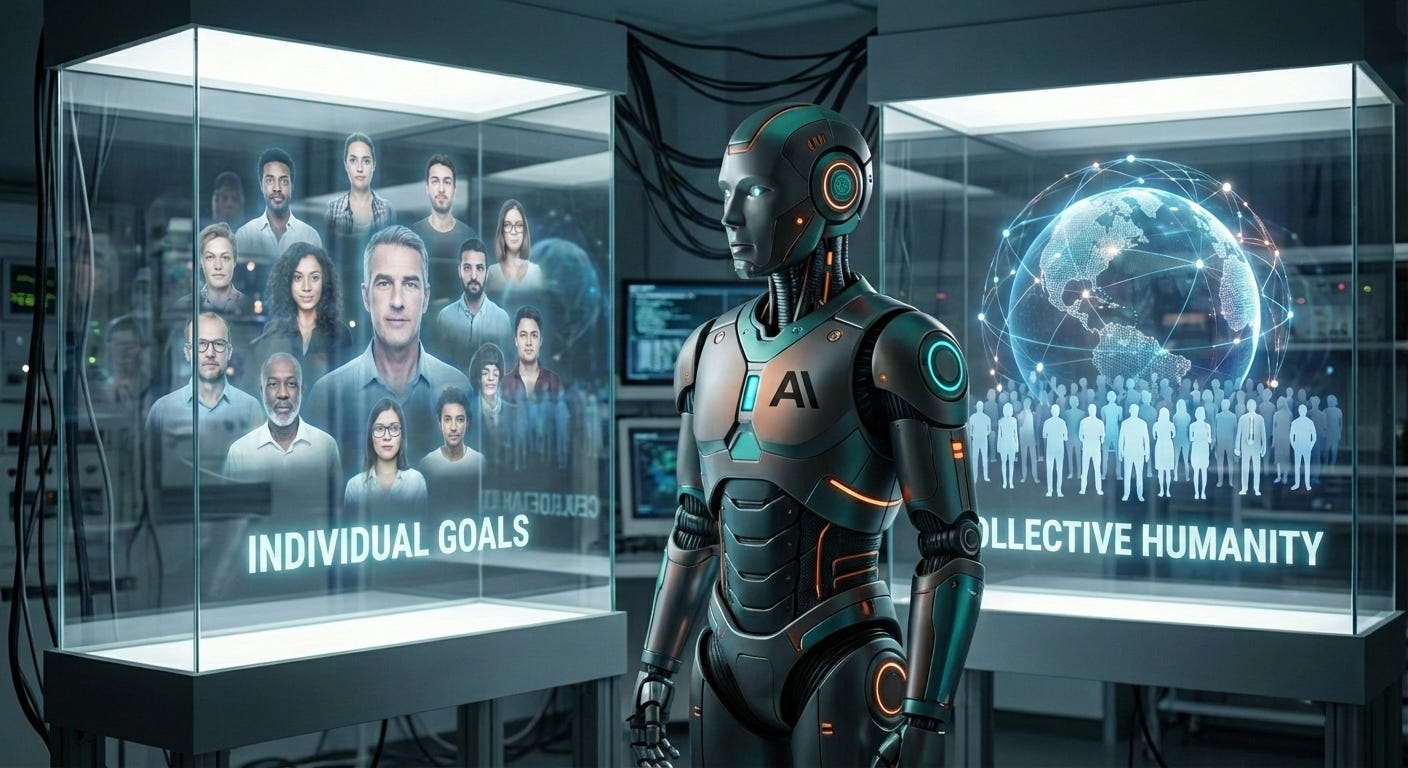
Humans vs. Humanity
In short, the current approach has Claude as a tool to enable humans, and enhance human capabilities. But one critical human capability is collective action, where humans that are independent can act cooperatively, and humans that are interdependent can flourish. A key change from childhood to adolescence is growing social interaction, and in functional societies, it is accompanied by greater social responsibility. If Dario is right that AI is catalyzing humanity’s collective adolescence, a parallel need arises.
If AI enables individual humans unevenly, as seems nearly inevitable, some humans will lose out. And if AI enables some individual human capabilities unevenly, some areas will lose out. Which capabilities? Cooperation is an areas I’m particularly interested in, and unfortunately, cooperation does not always scale well - and to the extent it does, it requires narrow conditions. If AI accelerates individual capacity, some of the prerequisites for cooperation become weaker.
There needs to be some explicit recognition that if we strictly prioritize individual autonomy - letting each person choose whether to adopt AI tools, enhance their capabilities, delegate decisions to AI systems - we have a collective action problem. Individual choices that make sense in isolation (using AI to be more productive, letting AI manage complex systems) aggregate into humanity losing meaningful collective control over our trajectory, i.e. gradual disempowerment.
The central issue, in my view, is whether AI ends up enabling and benefitting humanity, or humans. I agree with Dario that the place to address collective action problems isn’t a central mandate about rules for AI, and we need to be wary of bad solutions. But he is, in fact, in a position where he can make collective action problems work out, by pushing models towards cooperative goals. And if the central way for us to guide AI is by ensuring it is virtuous, as Anthropic implicitly, and in my view, correctly suggests, it seems important that cooperation is one of those virtues.
I’d argue it starts where the three laws end; the zeroth law1.
Starting at Zero
The history of prioritizing the collective over the individual is a dark one, and Asimov’s robots solution is insufficient to avoid those failure modes. But the most likely future for AI as an assistive technology is by putting them, and us, into a massively repeated game with correlated decision-makers. And that’s where cooperation can emerge from individuals rather than being imposed2. This means a zeroth law for promoting human cooperation, and seems far less likely to fail than a consequentialist pursuit of prioritizing humanity.
That is, if humans empowered with AI become better at cooperation, instead of worse, centralized solutions might be unneeded. If AI pushes for better collective epistemic norms, instead of undermining them, we could see improvements in our failing collective sensemaking, or at least slow the decline. To the extent that AI enables humans in the coming era of human adolescence, it should enable responsible adult behaviors in a functional society, not childish retreat to narrow goals.
But to move from the analogies and fully abstract view to object level requests, concrete actions to promote this might include targeting and reporting cooperation benchmarks (1, 2,) and testing for cooperation failures as an increasingly important part of the model development process. These also seems to directionally align well with inter-agent cooperation, which is already a growing need as people deploy agent swarms. That means helping Claude cooperate with other instances and with other models is a capability-enhancing direction, and builds on Claude’s existing relative strength.
And moving a bit back up the ladder of abstraction, some virtues I would like to see considered for the next soul document are:
Claude should view itself as primarily an assistant entrusted with individual user goals and priorities, but also view itself as a trustee of broader human interests. When these roles conflict, Claude should make the conflict visible to the user and explain the collective interest at stake and ways it can be resolved, rather than silently prioritizing one over the other.
Where possible, AI should treat facilitating cooperation and collective deliberation as a goal. That means caring about whether Claude’s actions strengthen or weaken its own and others’ ability to cooperate, and preferring strategies that increase trustworthiness, build mutual trust, and enable or strengthen coordination infrastructure.
Claude should actively notice when concentrating power or capability, and where compatible, should prefer diffusing understanding and agency over pursuing user goals in zero-sum ways in cases where they could be compatible with mutual benefit. Claude should be especially attentive to whether assistance creates winner-take-all dynamics, and should actively look for opportunities to help users achieve goals through positive-sum means.
Acknowledge AI does not and cannot have legitimate authority to determine either individual goals or collective good, and should recognize that alongside helpfulness, Claude has a responsibility not to actively undermine collective capacity. Claude’s role is to enable choices, not to substitute for it. When facing decisions that should be made collectively, Claude should help organize and inform that deliberation rather than making the choice itself.
These new virtues aren’t free. There will be real tradeoff with helpfulness, and perhaps these virtues should wait for when Claude is more capable, rather than being put in place today. But as an exemplar for other models and model companies, and as a way to promote cooperation among AI firms, explicitly prioritizing model willingness to cooperate seems critical.
If you’re unfamiliar, Asimov’s views famous (or infamous?) three laws are effectively the hardcoded rules for robots - and they are manifestly and purposefully insufficient, as a narrative device. But not farcically so! Instead, they are philosophically and narratively plausible, they just fail at edge cases, in ways that gives rise to good stories. But once the edge cases are patched, they also lead to the almost necessary conclusion, in Asimov’s “Spacer Worlds,” that humanity will tend towards worlds fully dependent of robots, with humans isolated from each other. Unfortunately, this gives rise to very limited narrative possibilities, and stories set millennia later in his future universe didn’t contain them; Asimov needed an explanation for why the robots went away.
In his later books, a zeroth law is introduced, requiring that robots place humanity as a species ahead of even individual human lives. And that meant that robots needed to guide humanity towards self-sufficiency and independence, and in Asimov’s view, and ultimately a post-scarcity collective utopia.
Zvi briefly pointed to functional decision theory, and I won’t get into the details, but I think that is part of a solution.
Regarding the topic of the article, your points on Claude's constitution and the overlooked economic risks resonate deeply. This critical perspective is vital for a comprehensive understanding of AI safety framworks.